
To be or not to be (in the lysosome), that is the question…
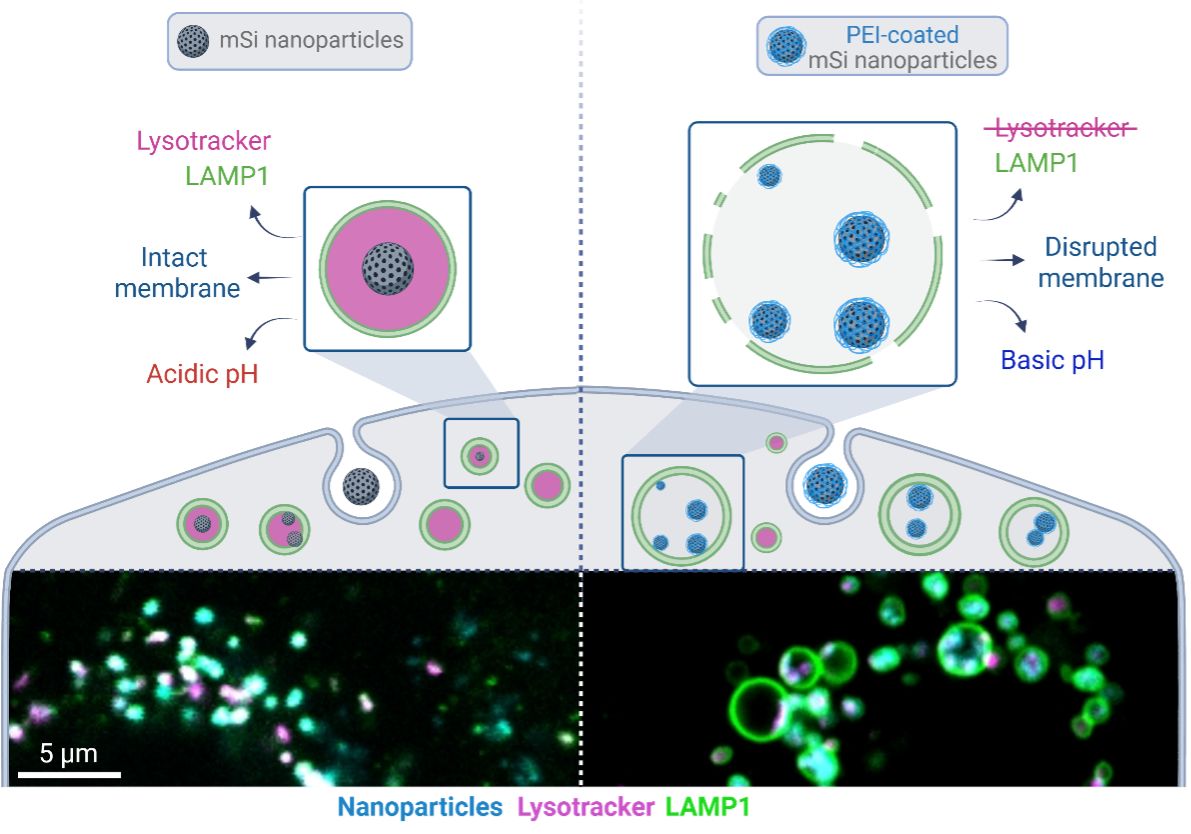
Do nanoparticles really escape from lysosomes?
That is the widely accepted hypothesis. And for years, we (and many others) have relied on the same readouts to “see” that escape happening.
A dye disappears. The signal separates. Escape achieved… right? 😅
As it turns out, things are not that simple…
In this work, we revisit one of the most widely accepted mechanisms in nanomedicine: the proton sponge effect. Using a combination of imaging, membrane damage assays, and a genetically encoded pH sensor, we show that proton-sponge-active nanoparticles do not necessarily escape lysosomes.
Instead, they do something more subtle: they partially disrupt the membrane and reduce lysosomal acidification. This is enough to let small molecules leak into the cytosol, but not enough for the nanoparticle itself to leave.
And importantly, the loss of Lysotracker signal, often interpreted as escape, can simply reflect loss of acidity rather than loss of the compartment. So what looks like “escape” may actually be something else entirely…
We hope this work helps clarify a long-standing debate and encourages a more careful interpretation of endosomal escape in intracellular delivery studies.
Huge kudos to Indra for taking the lead on this work, and thanks to everyone involved in pushing this project forward.
🔎 Curious? Check it out here.